What a sprinkler repair visit fixes
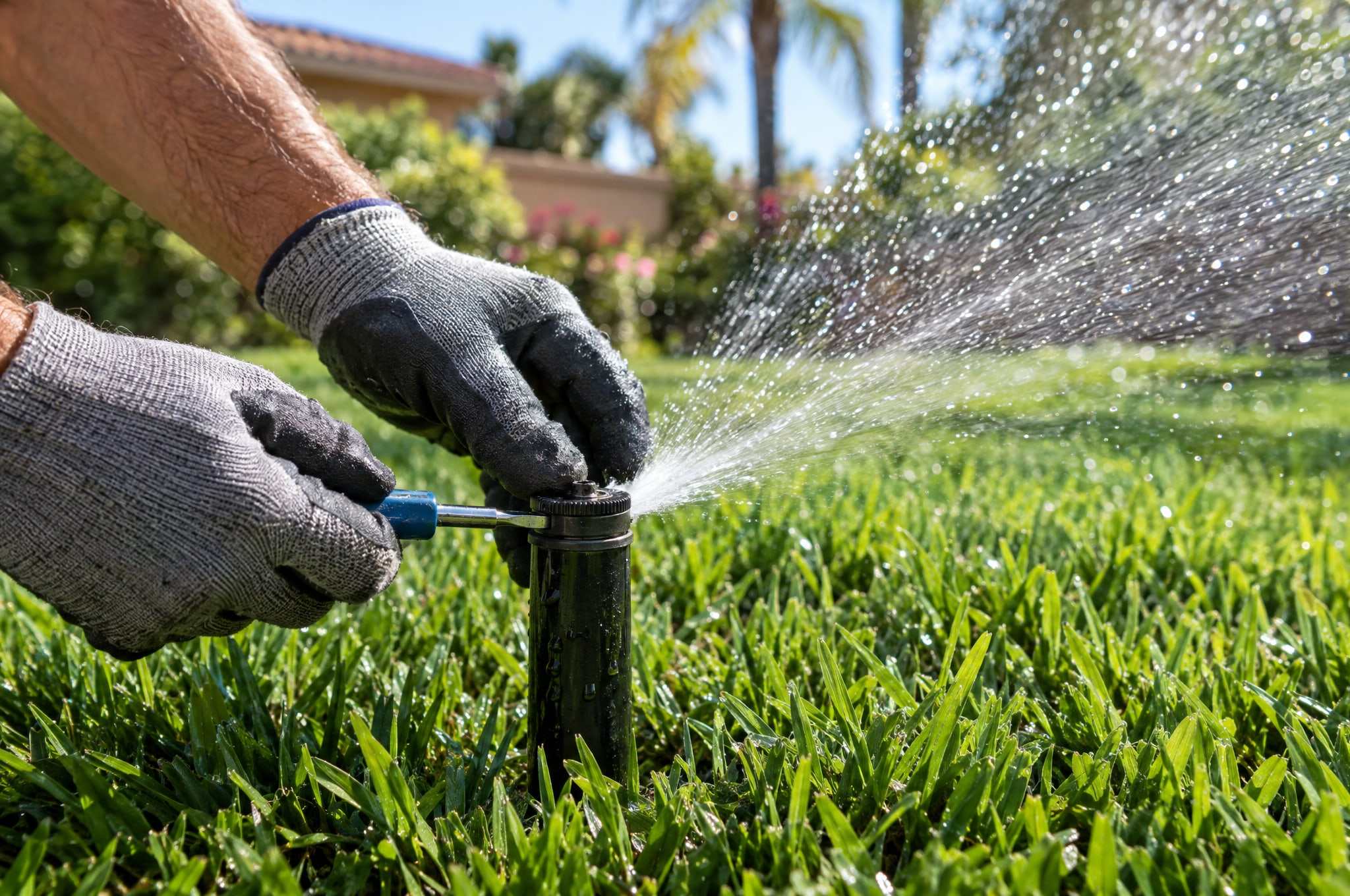
A sprinkler repair visit fixes the problems that waste water and brown out lawns: broken or sunken heads, misaligned spray, clogged nozzles, low pressure, leaking valves and controller settings that no longer fit the season. In Santa Clarita, irrigation problems are behind more lawn complaints than any pest or disease.
That is because our summers leave no margin. A coverage gap that would go unnoticed on the coast shows up within days in Saugus or Canyon Country when the afternoon hits triple digits.
Common sprinkler problems in SCV yards
These are the issues we find most often, roughly in order of how frequently they cause dry spots or wasted water.
| Problem | What you notice | Typical fix |
|---|---|---|
| Broken or cracked head | Geyser, bubbling or a flooded patch | Replace the head, sometimes the riser |
| Misaligned or tilted spray | Water on the sidewalk, a dry strip nearby | Straighten, adjust the arc, trim grass back |
| Sunken or buried head | Spray blocked by turf, ring-shaped dry spot | Raise the head to grade |
| Clogged nozzle | Weak, uneven or split spray pattern | Clean or replace the nozzle and filter |
| Low pressure | Short spray across a whole zone | Find the leak, partly closed valve or too many heads on the zone |
| Valve problem | Zone will not turn on or will not shut off | Clean or replace the diaphragm or solenoid, trace the wiring |
| Controller settings | Lawn wilts or runoff every cycle | Reset run times, add cycle-and-soak |
Mixed head types on one zone
One problem that is easy to miss is a zone that mixes spray heads with rotors. Sprays put water down much faster than rotors, so the spray-covered area gets soaked while the rotor-covered area stays dry. Matching the heads on each zone often fixes a stubborn dry spot that no amount of extra run time could.
Runoff on clay and slopes
Runoff happens when water lands faster than the soil can absorb it, and SCV clay absorbs slowly. On the slopes common in hillside tracts, the water also has somewhere to go: down the bank and into the gutter.
There are two practical fixes, and they work best together.
- Cycle and soak. Instead of one long run, the controller splits watering into two or three shorter cycles with a break between them. Each cycle soaks in before the next one starts.
- MP rotator nozzle retrofits. MP rotator nozzles fit most existing pop-up spray bodies and apply water far more slowly than standard spray nozzles, closer to the rate clay can absorb. They are one of the most cost-effective upgrades for a slope or a narrow parkway strip.
For how long and how often to run each zone, our guide on how often to water your lawn in Santa Clarita walks through it by season and grass type.
Smart controllers
A smart controller adjusts watering automatically based on local weather, so the yard gets less water on a cool week in April and more during a September heat wave. It also makes cycle-and-soak programming easy.
A smart controller cannot fix a broken system, though. If heads are tilted or clogged, it just schedules the wrong amount of water more intelligently. We always repair coverage first, then help you set the controller so it starts from accurate run times. SCV Water offers conservation programs that sometimes cover irrigation upgrades. Check SCV Water’s current programs before you buy anything, since eligibility and terms change.
Signs your system needs attention
You do not need to wait for a dead patch to call. A few quick checks tell you a lot about your system. Run each zone for a minute or two and watch it:
- Water reaching the sidewalk, street or the side of the house
- Heads that tilt, do not pop up fully or spit instead of spray
- Mist or fog rising from heads, which usually means pressure is too high
- A puddle that forms in the same spot every cycle
- A zone that keeps dripping long after the controller shuts it off
Any one of these is worth fixing before summer, when a small coverage problem becomes a brown lawn in a matter of days.
When to call us
The best time to have your system checked is early spring, before the first heat wave. Fescue lawns that go into June with perfect coverage come through summer far better than lawns where a broken head is discovered in July. It also makes sense to schedule a check after any landscaping project, since aerators, edgers and new plantings are all hard on heads and lines.
If you are converting part of the yard to plants, our drought-tolerant landscaping service includes converting those zones to drip. For a lawn that is too far gone to recover, sod installation starts with a fully checked system. We handle sprinkler repair across the valley, including older systems in Newhall and larger lots in Castaic. Request a free quote and tell us what you are seeing.